Officers
Affiliates
Calendar
Membership
Programs
Awards
Gardens
Youth members
Hybridizing
Growing tips
Judges
Links
Back to main page
NOTES TO THE PRESENTER OF
THIS PROGRAM
From Rita Gormley
Region 18 Assistant RVP
6717 Martha Dr. - Cedar Hill, MO 63016-2502
GormleyGreenery@aol.com
November 8, 2001
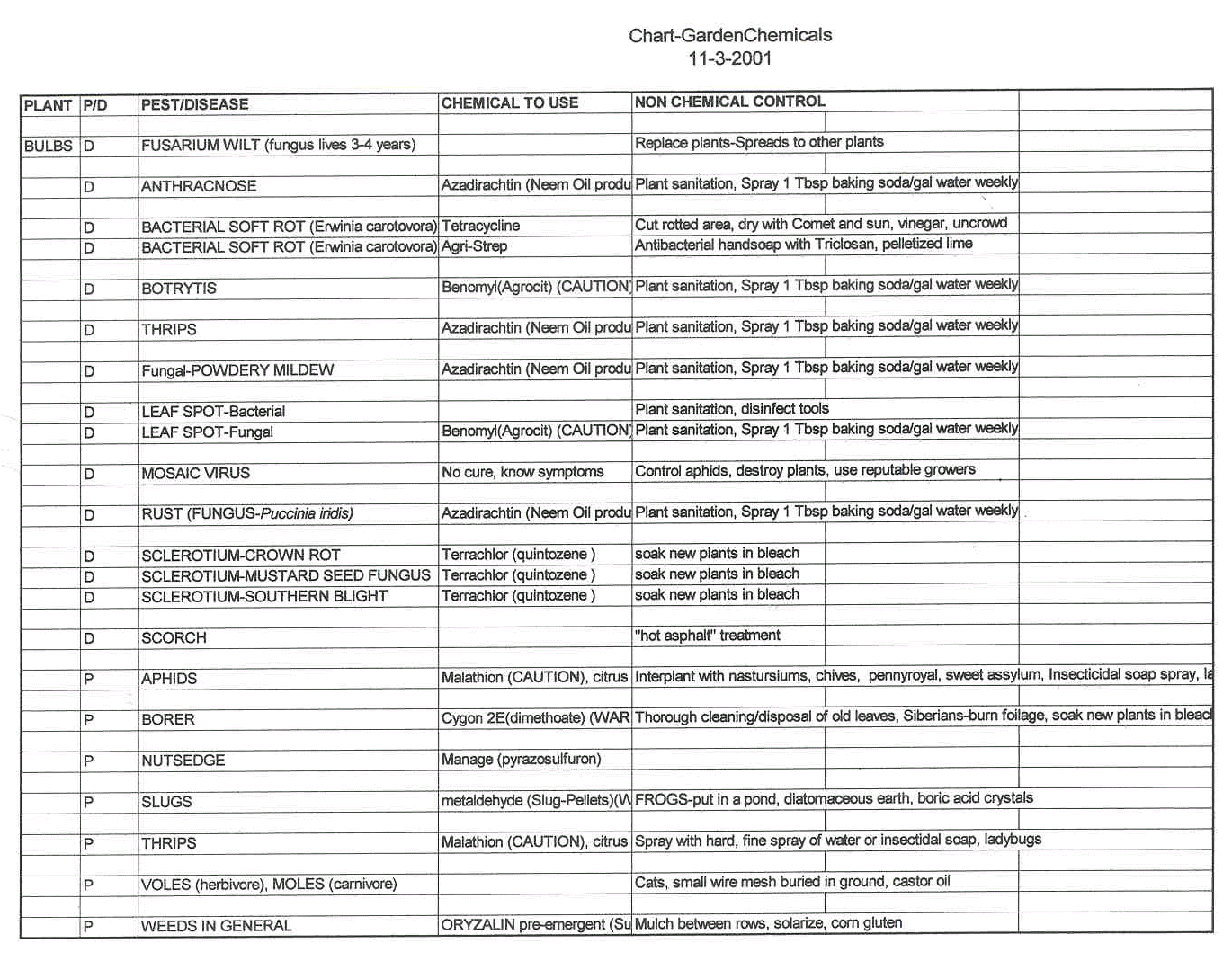
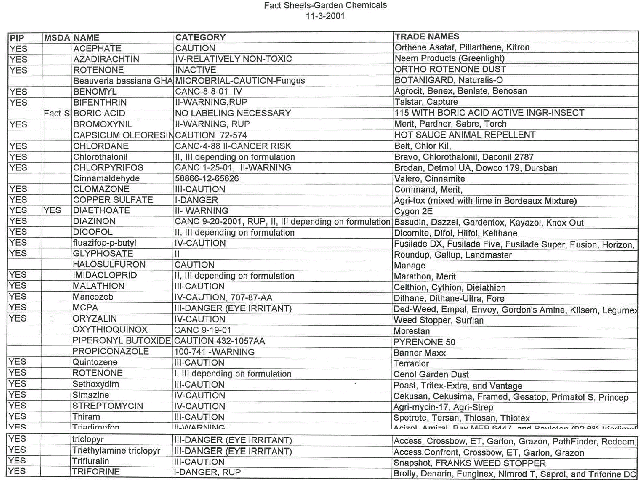
You are most welcome to use any and all of these materials to give a local program. Most of the specifics were gathered from the items mentioned in the Bibliography. The chart is my own condensation of this information.
These are my suggestions to you when presenting this program to local gardening groups:
1. Change the first three paragraphs to suit your personal credentials.
2. Take EMPTY CONTAINER samples of items to make the point of reading labels-household cleaners (CLOROX CLEAN-UP), repellents (OFF), and common garden chemicals (PREEN or ROUNDUP).
3. Make enough copies of the two Charts, and the two handout pages for all attending.
GARDEN CHEMICAL SAFETY & GARDEN HEALTH
4. Make a few copies of the Bibliography to give to those who are REALLY INTERESTED in the sources or further information on the searchable web sites. This complete program will be available to all through the AIS Region 18 website at http://www.region18.com so you can refer them to that resource.
5. It’s a dry subject so take bells, props, graphic pictures of iris borers, bugs, predators etc., to pass around and keep people awake. For my presentation, my husband dressed (exaggerately) in goggles, chemical mask, gloves, hat, while carrying a bar of Fels Naptha Soap and sprayer.
6. This also is a topic where there is an "overload" of information AND it changes daily, especially in the "Fact Sheet" area. Many articles recommend Brand Names that are no longer on the market (canceled shown in red) or too toxic (Class I or II) for me to recommend.
|
Handouts |
||
|
|
Each of these Charts are thumb nailed. Clicking on the thumb nail will link you to the larger picture. You may then "Save As" the Chart. |
|
|
Although
a lot of the information in these two Charts are available, they
are incomplete. For a more extensive chart, please contact the original presenter of this Program, requesting the chart information - Rita Gormley GormleyGreenery@aol.com |
||

| Return
to Top of Page |
GARDEN
CHEMICALS – Uses, Abuses, Alternatives |
Return
to Top of Page |
My credentials for this report are merely those of an enthusiastic gardener who is trying to garden safely both for the environment and myself. I inherited a troublesome shin condition that limits my exposure to most chemicals including soaps and detergents. In the course of dealing with garden pests and diseases, I have consulted many of my "expert" friends and acquaintances about what they use to deal with "garden yuckies" and found a great deal of disparity among methods. I then went to a variety of published sources to increase my understanding of health hazards involved with many of the "popular" chemicals and mixes and what the alternative might be.
I want to share with you what I found and although I have some handouts citing sources and very professional sounding names and information, I again want you to realize I am NOT a toxicologist nor a chemist, just an interested gardener with probably too much information to process. My findings make sense to MY gardening habit and view of ecology but may not suit YOUR view of the overall scheme of things. I am sure you will not necessarily agree with all of my "works for me" conclusions, or perhaps even some of them. I am sure, however, you will agree that an informed gardener is a safer gardener.
DISCLAIMER:
Each of the sources I have used for this program issues a disclaimer that basically
says: The author has made every attempt to provide up-to-date, scientific
information for the novice to solve …. pest control problems. The author
and publisher are in no way responsible for the application or use of the
chemical mentions …. Accuracy or adequacy of any of the information present
… and is not endorsing those companies or products listed. I too wish to
add the same sort of disclaimer. The information I am providing in the
program and handouts is accurate to the best of my knowledge and I am merely
expressing my view points to conclusions based on information provided
by others.
1. TO AVOID PESTS AND DISEASES:
-

Keep your garden clean – not only will the garden look better, hiding places for insects and disease will be removed. Crowded plants promote disease. Dispose of garden debris by burning, if possible. Do not compost!
-
Make sure the garden gets plenty of sun – trim back tree branches and let the sun dry up and sanitize dark spots where "bad things" grow.
-
Plant the right plant in the right spot. Take time to amend soil for bearded iris to promote drainage and combat rot.
-
Have soil tested for balanced fertility and pH. Strong plants are more disease resistant.
2. IDENTIFY YOUR ENEMY!!
-
Learn more about the pests/disease you are attempting to control by reviewing publications which discuss identification, biology and control strategies. There is a wealth of information readily available both printed and on the Internet.
3. THINK BEFORE USING PESTICIDES AND HERBICIDES
-
Pesticides and herbicides are not always an appropriate choice. More is not better or legal – apply only as directed on label All pesticides are poisonous! Learn how to read the label and apply safely.
4. UNDERSTAND YOUR PESTICIDE PRODUCT
-
A pesticide is any product that makes a claim to kill or repel pests including insects, rodents, slugs, birds, rabbits, weeds or brush, molds, bacteria and viruses. EPA Reg. No. on the label means this product IS a pesticide, including household cleaners (check the labels on your favorite home products-cleaners, insect repellents, disinfectants, etc.) READ THE LABEL!! It MUST provide information on all active ingredients, application, safety, storage and disposal. Know the hazards (Environmental toxicity statement) and longevity of the active ingredients (some dissipate quickly into component parts, others remain unchanged in the soil). Check out the main active ingredient.
5. CONSIDER ALTERNATIVE TO PESTICIDES
-
A learned gardener friend, a published author, magazines, bulletins are forever suggesting new (and sometimes old) methods that work for any problem. Keep a folder or binder on different methods for each problem to check the effectiveness in your own garden. Current gardening wisdom on plant health is simple. Healthy plants seldom have severe problems with pests and disease.
1. Read and follow instructions on labels carefully (more is NOT better!)
2. Wear protective clothing including gloves and long sleeves and pants to minimize absorption of chemicals by the largest organ in the body – the SKIN – and a mask when dealing with chemicals that should not be inhaled.
3. Wash your body and clothes upon completion of application.
4. Do NOT use chemicals near children, pets, food or pet food containers, water, ponds or fish tanks or children’s toys.
5. Store all chemicals in their original containers with labels attached in a safe place, out of reach by children or animals and write the date of purchase on the container.
6. Dispose of all chemicals and containers according to label instructions.
7. Know the name of the active ingredients and the telephone number of the poison control center in case of accident. (Missouri – 800-366-8888, Kansas – 800-332-6633)
In the interest of safety, I suggest you keep this list posted in a predominate place in your gardening area or books.
-
Handouts
Each of these Charts are thumb nailed. Clicking on the thumb nail will link you to the larger picture. You may then "Save As" the Chart.
Although a lot of the information in these two Charts are available, they are incomplete.
For a more extensive chart, please contact the original presenter of this Program, requesting the chart information - Rita Gormley GormleyGreenery@aol.com
-
Return to
Top of PageProgram – "Garden Chemicals – Uses, Abuses and Alternatives"
Return to
Top of Page
I. INTRODUCTION
(What I’m going to tell you)
General Garden Health – Make your garden inhospitable to pest and disease, hospital to you, pets, neighbors and the environment.
Garden Chemical – Uses, Abuses, Safety, locating information
Alternatives to Chemicals, IPM and Do-it yourself suggestions
A Wealth of Information – Bibliography
II. GARDEN HEALTH
(How does your garden grow? What can you do about it?)
Handout – GARDEN HEALTH – (see section/page entitled "Garden Health")
Your gardening style- meticulous/relaxed, efficient, economical?
Identify your real problems! There are 10,000 insects, 1,500 plant diseases, 600 weeds. One of the most important things to know is what you are trying to kill/cure. It is important to determine the cause of the problem.
III. GARDEN CHEMICAL
USES, ABUSES & SAFETY
(You have to be knowledgeable and careful)
Handout – GARDEN CHEMICAL SAFETY – (see section/page entitled "Garden Chemical Safety")
Type of Chemicals
Pesticides – means killer of pests. In the USA, there are over 17,000 registered pesticide products and over 800 related active ingredients. Insecticide, Pesticide, Fungicide, Herbicide, Miticide.
Fertilizers With chemicals and fertilizers, food production per farmer has gone from 3 people in 1776, 73 in 1970, 121 in 1995. Any chemical can do harm. Being organic doesn’t mean it doesn’t have potential for harm. Key is amount the body is exposed to chemical and for what duration of time. That you can easily purchase a pesticide does not mean it is safe.
C. Fundamentals for the Use of Garden Chemicals – EPA sets the standards.
Read the label BEFORE use. (See D. "Explanation of EPA Labels")
Use chemicals ONLY for
the recommended application.
Use ONLY the recommended amount.
Use caution while handling chemicals.
Keep chemicals in original container and out of the reach of kids and pets.
D. Explanation of EPA
Labels
All labels MUST have: (see sample provided here)
(Note to Presenter of this Program: Take EMPTY container samples of common Household Products with EPA labels – CLOROX CLEAN-UP, OFF DEEP-WOODS INSECT REPELLENT V, etc. to demonstrate.)
Product Name
WARNING: Signal Words – Caution, Warning, Danger, Danger-Poison
Directions for Use- what product does, when, where and how much to use
First Aid – Statement of Practical Treatment
Active Ingredients
Warranty Statement
Net Weight/Net Contents Statement
Manufacturers Name and Address
EPA Registration Number
EPA Establishment number – where final phase of production took place
Directions for Use
Precautionary Statements-Hazards to people and pets and precautionary actions
Environmental Hazards – fish, wildlife, dangers and how to avoid
Hazards of corrosively, flammability, etc.
Storage of Product and Disposal of unused product and container
Some labels are short, others lengthy depending on their use.
E. BASIC PRINCIPLES OF TOXICITY – Just How Toxic is this Stuff? It is important to remember that many pesticides are toxic.
|
TOXICITY CHART BASED ON EPA STANDARDS |
||
|
CATEGORIES |
SIGNAL WORD- HAZARD |
ORAL
LETHAL DOSE |
| I. Highly Toxic |
DANGER
- irreversible eye or skin damage. POISON OR SKULL OR CROSSBONES |
0-50 mg/kg 7 drops |
| 2. Moderately Toxic | WARNING |
50-500
mg/kg 1 tsp to 1 oz |
| 3. Slightly Toxic | CAUTION |
500-5000
mg/kg 1 oz to 1 pint |
| 4. Not Acutely Toxic | None/CAUTION |
5000 mg/kg 1 pint |
A. Pesticide Example in Selected Categories (refer to Toxicity Chart)
Category I (* indicates potential for irreversible eye or skin damage) Orthenex*, Vendex*, Isotox*, Mavrik 2E*, Captan (only the dust or powder)*, Triforin EC*, Lime Sulfur*, Copper Sulfate* (if it contains 99% copper sulfate)
Category II
Cygon 2E, Daconil 2787, Diazinon 25%, Metalaxyl, Rubigan, Permethrin, Nicotine
Category III
Avid, Carbaryl, Mavrik Aqua Flow, Captan 50W, Maneb, Mancozeb, Rubigan,
Sentinel, Pyrethris (organic), Acephate (Orthene), Malathion
Category IV
Benomyl, Copper Sulfate solution, Diatomaceous Earth, Sulfur, Neem oil, Safer
Soap
B. Dangers of Pesticides – all pesticides are toxic but not necessarily a hazard.
Toxicity is how toxic it is to animals – using the LD50 the greater the toxicity. For example, the LD50 of Diazinon is 350 mg/kg; the LD50 of Malathion is 2100 mg/kg. Diazinon has greater oral toxicity. It takes six times as much Malathion as Diazinon to kill you. Column 3 (of the Toxicity Chart) shows LD50 for man/oral. There are other EPA measures including oral/dermal, animals/birds/fish.
Hazard – toxicity and chance of toxic exposure-risk of poisoning/eye-skin damage.
Persistence –
how long it lasts. Pesticide persistence is often expressed in terms of half-life.
This is the time required for one-half the original quantity to break down.
Pesticides are divided based on half-lives: non persistent – less
than 30 days; moderately persistent – 30 to 100 days; and persistent –
greater than 100 days.
IV. ALTERNATIVE TO
CHEMICALS
(So what do you do instead?)
INTEGRATED PEST MANAGEMENT (IPM) is a term that is gaining popularity. This does not preclude using sprays although a spray is chosen with minimal impact outside of the knocking down a specific pest. It is a temporary solution. Repeated spraying is proof that the garden’s ecology is still imbalanced. Success with integrated pest management is based upon getting to know your garden, both the flowers and the other living things in it. Introducing a natural predator in your garden is often a permanent solution to a pest problem. It is also important to provide a suitable environment for the predators in your garden and to attract new ones. Many insect predators need an alternate food source, such as tiny flowers rich in nectar. Pest control materials are selected and applied in a manner that minimizes risks to human health, beneficial and non-target organisms, and the environment. Integrated Pest Management works best when you look at your garden as small ecosystem. After the planting is completed, your job is merely to help nature maintain a healthy balance. And often that is best done by leaving things to nature.
The National Integrated Pest Management Network (NIPMN) is the result of a federal-state extension partnership dedicated to making the latest and most accurate pest management information available on the World Wide Web. Participating institutions have agreed to a set of standards that ensure science-based, unbiased pest management information.
|
To reduce the pesticide load in the environment |
|
To increase the predictability and thereby the effectiveness of pest control techniques |
|
To develop pest control programs that are economically, environmentally, and socially acceptable |
|
To marshal agencies and disciplines into integrated pest management programs |
|
To increase utilization of natural pest controls |
Four Points of IPM:
|
Prevention of pest populations |
|
Application of pesticides only "as needed" |
|
Selecting the least hazardous pesticides effective for control of targeted pests. |
|
Precision targeting of pesticides |
What does "integrated" mean? The use of two or more pest management techniques (Inspection, Identification, Sanitation, Cultural, Mechanical, Biological and/or Pesticides) to achieve established pest management objectives. These are divided into three (3) groups – Nontoxic controls, Less-toxic controls, and Most-toxic controls.
Nontoxic Controls
|
Change cultural conditions: light, water, soil pH and fertility, or mulch. |
|
Correct nutrient deficiencies or excesses. |
|
Adjust maintenance: remove or mow weeds, avoid leaving plants wet after sundown, prune to increase air circulation. |
|
Tolerate some leaf damage, often up to 20 to 30 percent, and allow plants to recover naturally over time. |
|
Be careful with garden hygiene: remove and dispose of diseased or infested plants or plant parts; clean up and compost garden debris in the fall. |
|
Use physical controls, such as traps, barriers, detection tools, and removal of pests by hand or with water spray. |
|
Try biological controls (organisms that limit pests): natural predators, parasites, nematodes, fungi, bacteria, and beneficial viruses. Avoid using chemicals that kill such organisms. |
Less-toxic Controls
|
Use controls that target specific taxonomic groups, eating habits, or life stages: insecticidal soaps, horticultural oils, pheromones, and growth-regulating natural substances such as neem oil. |
|
Select target-specific synthetic pesticides: insecticides, fungicides, herbicides, and bactericides. These often must be applied at a specific point in the life cycle of the pest or disease. |
|
Use systemic and pre-emergent synthetic chemicals (substances that can suppress problems before they emerge). |
Most-toxic Controls
|
As a last resort, consider using broad-spectrum chemical poisons. These,
however, kill organisms indiscriminately upon contact and can cause harm
to the environment or to you and others. Thus, they should be used with
extreme care. Chemical and botanical (tobacco, pyrethrum, hellebore, camphor,
limonene-citrus, neem tree, rotenone-legume, soaps) |
Methods stress cultural, mechanical and biological controls with strict avoidance or limited use of insecticides, fungicides or herbicides unless naturally occurring or derived from natural sources.
Cultural - cultivating and weeding disrupts weeds, buries insects or exposes them to adverse weather. Crop rotation, intelligent use of fertilizers and water can promote healthy plants, enhancing ability to resist disease. Interplanting with certain other plants may decrease certain insects. Plant disease resistant varieties and patronize hybridizers who do not "baby" their introductions.
Mechanical – hand weeding, mulching for weeds, slug traps
Biological – predators like praying mantis, ladybugs, (leave when food supply is gone)
V: CONCLUSION
(What I just told you)
General Garden Health – Make your garden inhospitable to pest and disease, hospitable to you, pets, neighbors, and the environment
Garden Chemicals – Uses, Abuses, Safety, Locating Information
Alternatives to Pesticides, IPM and Do-it-yourself suggestions
A Wealth of Information – Bibliography
Other Notes to the Presenters of this Program
During the research for this program, I read more carefully all of my favorite books on Irises, looking for citations to increase my knowledge on pests/diseases and chemicals. I purchased one book that is truly a gem of an addition to my library of gardening and its associated pitfalls COMPLETE GUIDE TO PEST CONTROL – WITH AND WITHOUT CHEMICALS (Third Edition 1996) by George W. Ware from which I extracted some of the information in the chart I have prepared for this presentation. I also e-mailed many commercial growers that I respect to ask for assistance. I have copied portions of much e-mail on Iris-talk, the Internet list for Iris fanciers. I have amassed a wealth of articles, listed in the Bibliography along with general informational resources on growing/culture/garden chemicals. I urge you to read them. If you have a favorite resource that I did not use, please let me know as I hope this program will span a wide range of experience and knowledge.
While doing the charts, I gathered some of the information from the EPA records (which may or may not be up-to-date). Some of the Standards that went to effect in 1996 are just now being implemented and others are scheduled for effective dates in the near-future so the HAZARD designation of chemicals is current to the best of my knowledge. The Hazardous for MY use were not included in the charts. Organic/natural ingredients are not necessarily better/effective but I believe in IPM and doing all the "least chemical method" as the first solution to pests and diseases.
There are 893 active AI’s
There are 11633 active products
In other words, use your own judgment but I hope this information makes you able to judge better!
Books:
Ware,George W. Complete Guide to Pest Control – With and Without Chemicals. Third Edition. 1996. Available from Thomson Publications, P.O. Box 9335, Fresno, CA 93791 www.agbook.com $29.95
Warburton, Bee, Ed. The World of Irises. Wichita, KS: The American Iris Society, Third Printing, 1995.
Lawton, Barbara Perry Magic of Irises. Golden, CO: Fulcrum Publishing. 1998. The Philosophy of Plant Health Care, pages 143-147. Insect Pests of Irises, pages 148-159, and Bacterial, fungal and Viral Diseases, pages 160-168.
Shear, William The Gardner’s Iris Book. Newtown, CT: The Taunton Press, Inc. 1998
Pests & Diseases. Time-Life Books. Alexandria, VA. 1995
Input from knowledgeable people:
"Crop Protection Chemicals Reference, Chemical and Pharmaceutical Press." 2001. 17th Edition Crop Protection Reference or our New Electronic CD-ROM Products: E-Mail: cpp@cppress.com, Order at http://www.cppress.com/html/books/booksfrm.html (expensive!)
Weed Control Guide for Missouri Field Crops. A U of MO Extension Publication #MP575. Agronomy Guide MFA Agri-Service. A yearly publication of MFA’s products for crops and general gardens. Ask for it at a local MFA. It is an excellent reference and free.
Articles/pamphlets:
Articles by Terry Aitken
AIS Bulletin, April, 2001; page 57
AIS Bulletin, April, 2000; page 82
AIS Bulletin, April, 1999; page 48
Fine Gardening. August 2001. Page 7- Poison Free Insecticidal Soap. Page 24 – grub article with chemicals to control. Page 48 – Say Goodbye to Weed Worries. Page 50 – choose controls that are effective and safe, etc.
Article by Rick Tasco – Growing Techniques – AIS Bulletin, July, 1999; pages 31-32
Taunton Press Kitchen Gardener #26, pp. 12-16. April/May, 2000. Attracting Beneficial Bugs by Joe Queirolo
Taunton Press Fine Gardening #73, pp. 61-63. May/June, 2000. An Integrated Approach to Pest Control by Richard Devine
Taunton Press Kitchen Gardener #29, pp. 16-19. October/November, 2000. Brewing Compost Tea by Elaine R. Ingram
CITIZEN’S GUIDE TO PEST CONTROL AND PESTICIDE SAFETY. EPA730-K-95-001. United States Environmental Protection Agency
Perdue Pesticide
Programs, Perdue University Cooperative Extension Service, West Lafayette,
IN 47907 http://www.btny.purdue.edu/PPP/PPP_pubs.html PPP-29
PESTICIDES AND THE HOME, LAWN AND GARDEN
Internet Searchable Sites:
"iris-talk" E-Mail List ("iris-talk" is the largest discussion group and is open to anyone wishing to discuss just about anything relating to any type of iris. There are over five hundred subscribers worldwide, though most are from the USA. Many are members of the AIS, but non-members are welcome and encouraged to join as well. The list is hosted by Yahoo!Groups. Information on joining the iris-talk list can be found at: http://groups.yahoo.com/group/iris-talk
Beyond Pesticides – Safety Source for Pest Management
Beyond Pesticides provides the public with useful information on pesticides and alternatives to their use. Chemical Factsheets, publications, legislation updates and news are provided. http://www.beyondpesticides.org
C&P Press, Inc. (Chemical and Pharmaceutical Press). Pesticide Labels & MSDS, searchable by Product name or manufacturer. http://www.greenbook.net/free.asp
California EPS-Department of Pesticide Regulation. http://www.cdpr.ca.gov/docs/label/m4.htm
MadSciNet. The 24-hour exploding laboratory. http://www.madsci.org/
Pesticide Action Network - Pesticide Database. http://data.pesticideinfo.org/
Internet – Integrated Pesticide Management
|
UC IPM Online http://axp.ipm.ucdavis.edu |
|
National IPM Network http://ipmwww.ncsu.edu |
|
Database of IPM Resources http://ippc.orst.edu/cicp |
|
Radcliffe’s IPM World Textbook http://ipmworld.umn.edu |
EXTOXNET – Extension Toxicology Network – Pesticide Information Profiles, Pesticide Information Project of Cooperative Extension Offices of Cornell University, Oregon State University, the University of Idaho, the University of California at Davis and the Institute for Environmental Toxicology, Michigan State University. EXTOXNET primary files maintained and archived at Oregon State University. http://www.ace.orst.edu/info/extoxnet/
This is the format:
EXTOXNET – Extension
Toxicology Network – Pesticide Information Profiles
ACTIVE INGREDIENT
TRADE OR OTHER NAMES: … is found in a variety of commercial insecticides. The products … all contain … as the active ingredient
REGULATORY STATUS: … is a General Use Pesticide, and is classified by EPA as both a toxicity class II and class III agent, and must be labeled with the signal work "Warning" or "Caution"
INTRODUCTION: … is a systemic, … insecticide with soil, seed and foliar uses for the control of sucking insects including rice hoppers, aphids, thrips, whiteflies, termites, turf insects, soil insects and some beetles. It is most commonly used … The chemical works by …. Are available as dustable powder, granular, seed dressing, soluble concentrate, suspension concentrate, and wettable powder. Typical application rates …..
TOXICOLOGICAL EFFECTS:
|
Acute Toxicity: … is moderately toxic |
|
Signs and Symptoms of Poisoning: Although no account of human poisoning was found in the literature, signs and symptoms of poisoning would be expected to be similar to nicotinic signs and symptoms, including fatigue, twitching, cramps, and muscle weakness including the muscles necessary for breathing (330). |
|
Chronic Toxicity: A 2-year feeding study in rats fed up to 1,800 ppm resulted in a No Observable Effect Level (NOEL) of 100 ppm |
|
Reproductive Effects: |
|
Teratogenic Effects: |
|
Mutagenic Effects:… may be weakly mutagenic |
|
Carcinogenic Effects: … is considered to be of minimal carcinogenic risk, and is thus categorized by EPA as a "Group E" |
|
Organ Toxicity: |
|
Fate in Humans and Animals: … is quickly and almost completely absorbed from the gastrointestinal tract, and eliminated via urine and |
ECOLOGICAL EFFECTS
|
Effects on Birds: … is toxic to upland game birds. It was concluded that the risk of dietary exposure to birds via treated seeds was minimal. |
|
Effects on Aquatic Organisms: … The toxicity of … to fish is moderately low. Products containing … may be very toxic to aquatic invertebrates. |
|
Effects on Other Animals (Nontarget species): … is highly toxic to bees if used as a foliar application, especially during flowering, but is not considered a hazard to bees when used as a seed treatment (1). |
ENVIRONMENTAL FATE
|
Breakdown of Chemical in Soil and Groundwater: The half-life of …. in soil is … days, depending on the among of ground cover (it breaks down faster in soils with plant ground cover than in fallow soils) |
|
Breakdown of Chemical in Surface Water: |
|
Breakdown of Chemical in Vegetation: |
|
Analytic Methods: |
PHYSICAL PROPERTIES AND GUIDELINES
|
Appearance: |
|
Chemical Name: |
|
CAS Number: |
|
Molecular Weight: |
|
Water Solubility: |
|
Solubility in Other Solvents: |
|
Melting Point: |
|
Vapor Pressure: |
|
Partition Coefficient: |
|
Adsorption Coefficient: |
|
Exposure Guidelines |
|
ADI: |
|
MCL: |
|
RfD |
|
PEL: |
|
HA: |
|
TLV: |
BASIC MANUFACTURER REFERENCES
References for the information in this PIP can be found in Reference List Number
10
DISCLAIMER: The information in this profile does not in any way replace or supersede the information on the pesticide product label/ing or other regulatory requirements. Please refer to the pesticide product label/ing.
Other Valuable Information:
Regional Poison Center
Cardinal Glennon Children’s Hospital
1465 S. Grand Blvd. St. Louis, MO 63104
Emergency Phone(s): 800-366-8888; 314-772-5200
Administrative Phone: 314-772-8300
E-mail: mthompson@ssmhcs.com
Mid-American Poison
Control Center
University of Kansas Medical Center
3901 Rainbow Blvd., Room B-400, Kansas City, KS 66160-7231
Emergency Phone 800-332-6633 (KS only); 913-588-6633; 913-588-6639 (TDD)
Administrative Phone: 913-588-6638
E-mail: tkay@kumc.edu or loller@kumc.edu
State of Missouri,
Department of Agriculture, http://www.mda.state.mo.us
Product Information – Pesticide Database Searches http://www.kellysolutions.com/MO/showproduct/info.asp